Services
Solar that puts you in a better spot from day one
Simple, honest help. If solar will save you money and improve your situation, I will show you how. If it will not, I will tell you that too.
No money down
No-cost solar through the state agreement
With a power purchase agreement, you go solar with $0 down. You keep your money in your pocket. If your home qualifies, the system is fully covered by the available funding. Qualifying simply means your home has what solar needs to perform well:
You stay free of any loan, debt, lien, or investment, so your finances stay completely yours. This is the simplest part of the whole conversation.
My promise
Going solar only makes sense if it puts you in a better situation from day one. That means a better rate, or protecting what you already have. If the numbers do not do that for you, I will say so.
Batteries keep your own power working for you
Your system is sized to produce the power your home uses across the full year. Under the current net metering rules, power you send back to the grid is credited at the supply rate, so the smart move is to keep more of your own power. We store as much of it as possible in batteries for you to use day and night, instead of sending it back.
Your batteries do double duty. They also keep your lights on with backup power during storms or any grid outage, so your home stays comfortable and protected.
One team, start to finish
One company handles everything
Jose is an independent consultant contracted through Ion Solar. Here is how it works. The solar provider acts as your utility. Ion runs the analysis to find qualified homes and builds a personalized energy savings report for your home, sizing the panels to the exact power your home uses across the year.
If your home qualifies and the savings are there, Ion handles everything else for you:
- CAD drawings
- Permits
- Installation
- Monitoring
- Maintenance
- Service agreements
- Equipment insurance
- Coverage for any home damage from the solar
One company, from start to finish. Many companies split this across three different companies for the analysis, the install, and the service. Homeowners tell us they would rather have one team that owns the whole process, so that is exactly what you get.
How the credits work
How net metering works for you
Your meter tracks the energy flowing in from the grid and the excess energy flowing out to the grid. The current Illinois on-site net metering method applies to systems turned on after January 1, 2025. Excess power you generate but do not use is banked as a Supply Carryover credit that you can use in later months.
The key point
Net metering lowers your supply charge, and it can reach $0 when your credits cover your usage. Your delivery charges and taxes apply to each kWh you pull in from the grid, so using and storing your own power with batteries keeps more of those kWh at home and puts you further ahead.
Learn more: two real bill examples
These are real, anonymized Ameren Illinois outcomes that show net metering bringing the supply charge down, including all the way to $0. With delivery and taxes tied to each kWh from the grid, keeping your own power is what puts you ahead.
The home used a little more than the system made that month
- Energy pulled in from the grid
- 983 kWh
- Excess sent out to the grid
- 642 kWh
- Prior banked credit applied
- 287 kWh
- Billable supply left
- 54 kWh
Net metering credits cut the supply charge down to just $6.52.
The system made more than the home used that month
- Energy pulled in from the grid
- 913 kWh
- Excess sent out to the grid
- 997 kWh
- Banked for next month
- 1,203 kWh
- Billable supply left
- 0 kWh
Supply hit $0.00 and 1,203 kWh was banked for later. Delivery and taxes are still owed, which is why keeping your own power is so valuable.
Know where your money goes
Read your electric bill
Once you can read your bill, you can see exactly where your money goes. Below is a real Ameren Illinois sample bill with the personal details removed. Tap any highlighted part of it, or any label beneath it, and it opens a plain-English note on what that piece means. Start with the overview page, then open the itemized charge detail.
Your Ameren bill: the overview page
Page 1 shows what you owe, your account details, a charge summary, your usage graphs, and the payment stub.
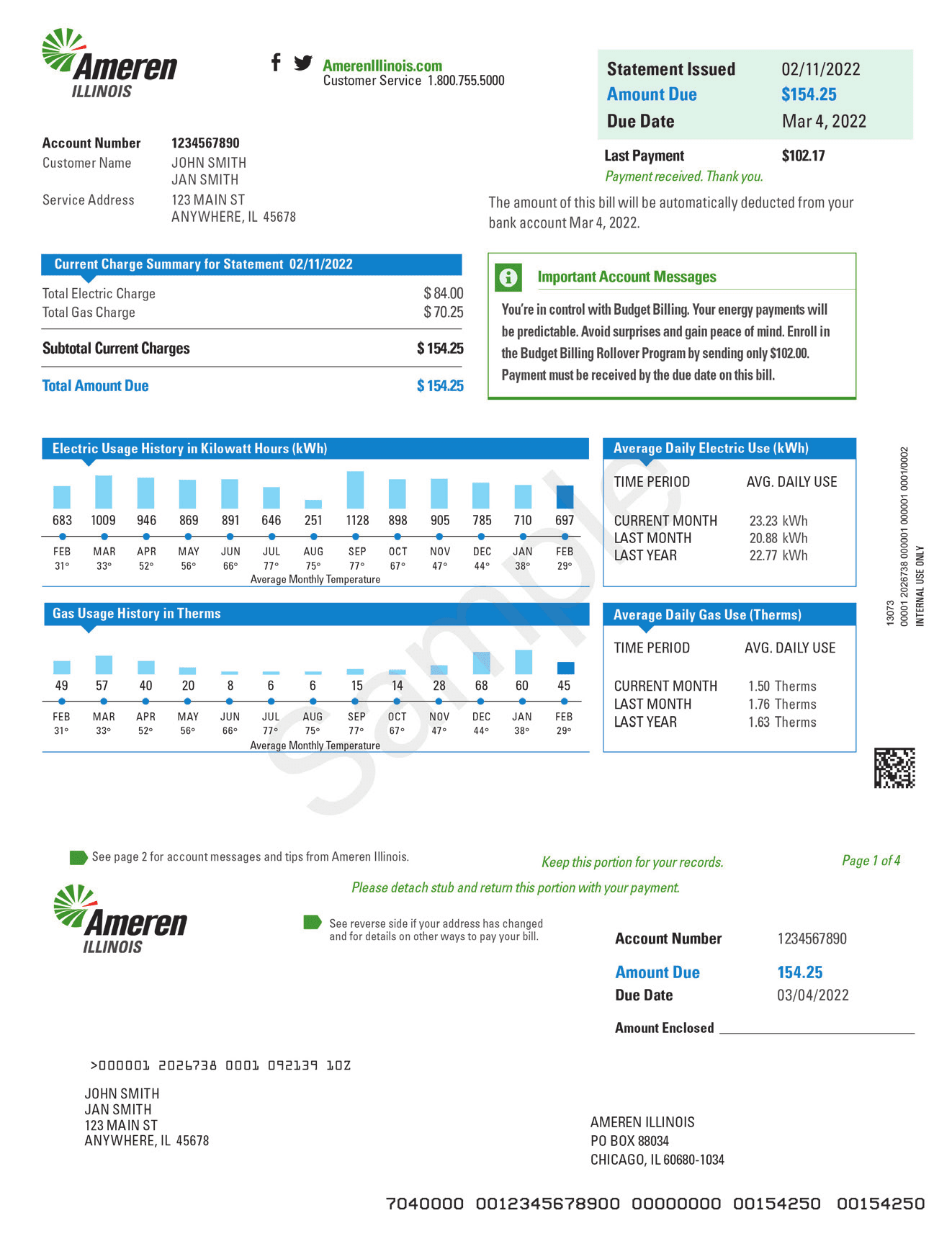
Tap any highlighted number on the bill above, or a label below, to see what that part of your bill means.
Your Ameren bill: the charge detail page
The itemized page reads your meter, then splits the cost into delivery, supply, and taxes so you can see exactly where each dollar goes.
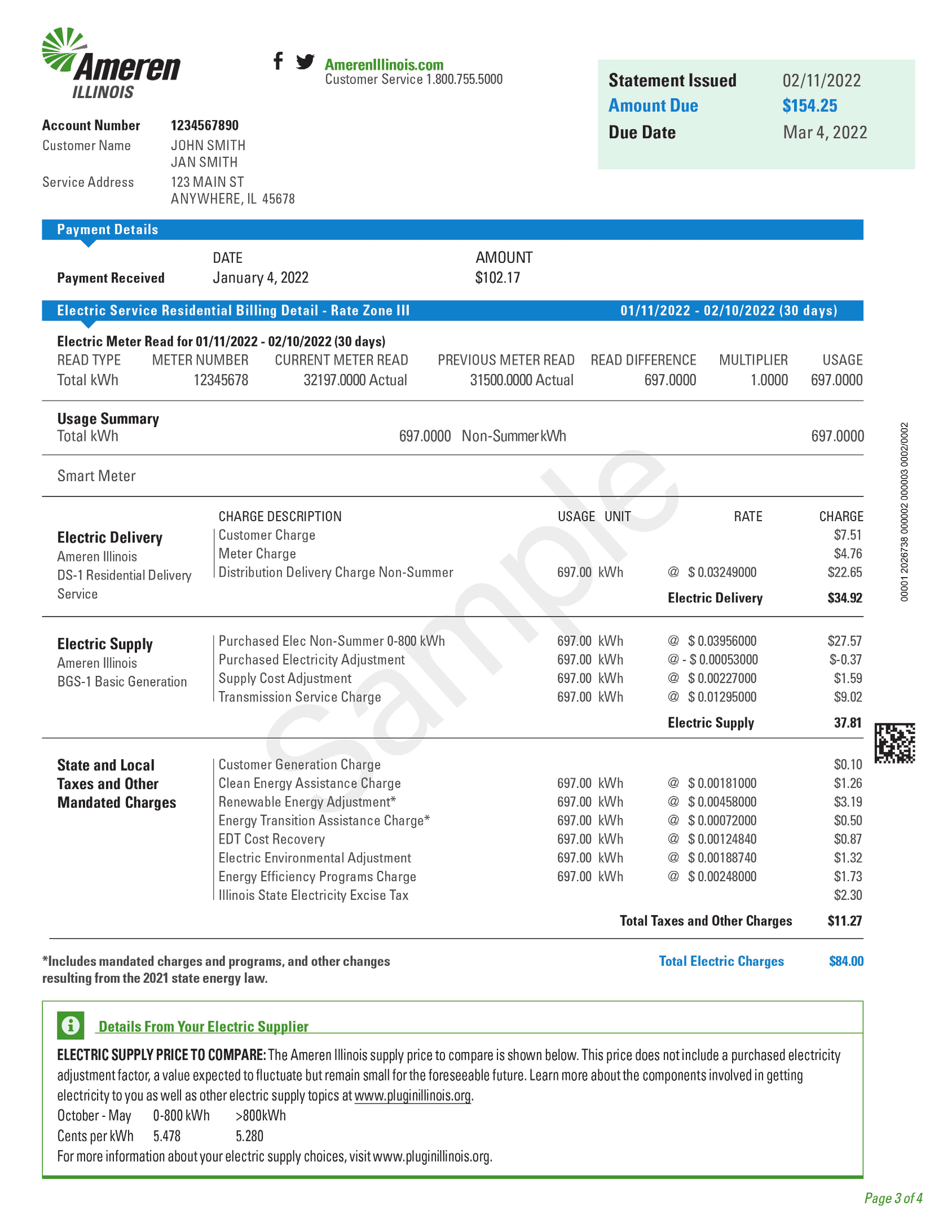
Tap any highlighted number on the bill above, or a label below, to see what that part of your bill means.
The good news in those numbers: you are already paying toward solar and clean energy through your bill today. Going solar simply puts that money to work for your own home.
Prefer the dollar amounts? See a full itemized bill
A realistic, anonymized Ameren Illinois bill broken into supply, delivery, and taxes, with the exact dollar amounts. Hover or tap any charge for a plain-English definition. A ComEd example is included for homes in that territory.
ComEd
Sample Customer · 884 kWh · 30 days
Total
$130.64
Supply
$60.09The electricity itself. This is the part rooftop solar can offset, and net metering can bring it close to or all the way down to $0.
- Electricity Supply Charge$47.29
- Transmission Services$12.91
- Purchased Electricity Adjustment-$0.11
Delivery
$41.20The cost to bring power to your home over the poles and wires. You pay this on every kWh you pull from the grid, even with solar.
- Customer Charge$8.05
- Standard Metering Charge$3.16
- Distribution Facility Charge$28.82
- IL Electricity Distribution Charge$1.17
Taxes & Fees
$29.35State and local taxes plus state-mandated programs. Several of these fund Illinois solar and clean energy, which means you are already paying toward solar today.
- Renewable Portfolio Standard$4.44
- Zero Emission Standard$1.72
- Carbon-Free Energy Resource Adjustment$10.97
- Environmental Cost Recovery$0.32
- Energy Efficiency Programs$2.44
- Energy Transition Assistance$0.64
- Franchise Cost$0.76
- State Tax$2.92
- Municipal Tax$5.14
You are already paying toward solar
The highlighted line items are state-mandated charges from the 2021 Illinois clean-energy law that fund solar and renewables across the state. On this sample ComEd bill that is $17.13 this month. Going solar lets that money start working for your own home.
Plain-English definitions for every charge+
- Electricity Supply Charge ($47.29)
- The price of the energy you used, per kWh.
- Transmission Services ($12.91)
- Moving power over high-voltage lines to your area.
- Purchased Electricity Adjustment (-$0.11)
- A small true-up so the price matches the actual cost of power.
- Customer Charge ($8.05)
- A fixed monthly charge to keep your account and connection, billed no matter how little you use.
- Standard Metering Charge ($3.16)
- Reading and maintaining your meter.
- Distribution Facility Charge ($28.82)
- The local poles, wires, and equipment that deliver power to your street.
- IL Electricity Distribution Charge ($1.17)
- A state distribution charge based on how much you use.
- Renewable Portfolio Standard ($4.44)
- Funds Illinois solar and wind farms. You are already paying toward renewables right here.
- Zero Emission Standard ($1.72)
- Supports carbon-free energy generation in Illinois.
- Carbon-Free Energy Resource Adjustment ($10.97)
- Supports carbon-free generation under Illinois law.
- Environmental Cost Recovery ($0.32)
- Recovers approved environmental program costs.
- Energy Efficiency Programs ($2.44)
- Funds rebates and efficiency programs you can use.
- Energy Transition Assistance ($0.64)
- Supports the state's move to clean energy.
- Franchise Cost ($0.76)
- A local fee for using public rights of way.
- State Tax ($2.92)
- Illinois electricity tax.
- Municipal Tax ($5.14)
- Your city's electricity tax.
Learn more about Illinois energy and solar
The Illinois Renewable Portfolio Standard
Illinois has had a Renewable Portfolio Standard in place since 2009. It funds the state's solar and wind farms. You can see it on your bill as the Renewable Portfolio Standard line on ComEd and the Renewable Energy Adjustment on Ameren. In other words, you are already helping pay for solar today.
The same programs help you go solar
Those programs fund solar across Illinois, and that same clean-energy push is what makes rooftop solar affordable for your home or business today. You have already been helping pay for the grid of the future. This is your chance to put your own roof space to work and own a piece of it.
Growing demand from data centers
New data center development across the region is increasing electricity demand. Producing and storing your own power is a smart way to take control of your energy and protect your household budget as that demand grows.
Prefer to own it
Want to own your system?
Some homeowners would rather purchase their system and keep every bit of the long-term savings, plus the added value to their home. If that is you, I am glad to walk through ownership and the Illinois incentives that help, so you can compare it side by side with the no-cost agreement and pick what is best for you.
Want to keep more of your electric bill money in your pocket?
Get a free, no-pressure bill review. I will walk you through your charges and tell you honestly whether solar makes sense for your home.